
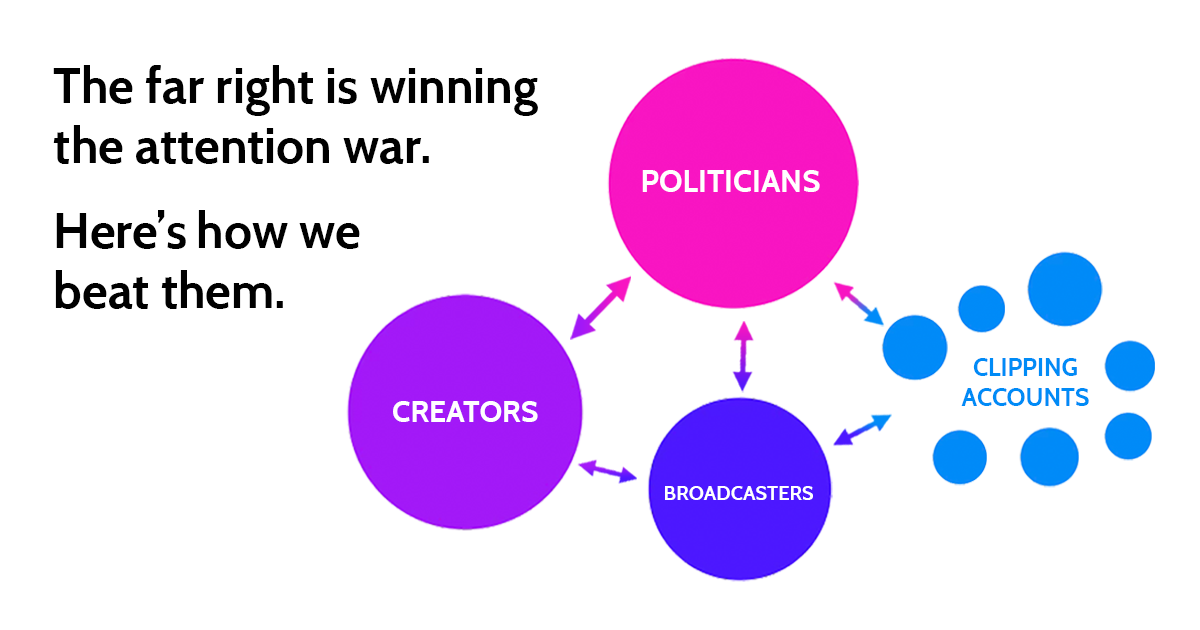
You may have heard people talk about building a progressive ecosystem online. But what does that actually mean?
Something big has shifted in UK politics over the last decade. The far right has grown in power, anti-migrant narratives have moved into the mainstream and Reform is predicted to be the largest single party at the next election. There are many reasons for this, from economic insecurity and failures of Tories and Labour, to growing distrust in institutions.
But one factor is often overlooked. The far right have realised something crucial: social media isn’t just another communications channel. It’s where narratives are born, media agendas are set, and political power is built.
Understanding how they built power online will help us fight back and win.
In July 2025, activists started fixing St George’s and Union Jack flags to lampposts in Weoley Castle, a suburb of Birmingham. The stunt quickly spread. Photos and videos were shared through Facebook groups, WhatsApp networks, influencers, livestreams and podcasts.
Social media helped turn Operation Raise the Colours from a local stunt into a national story. Within weeks, thousands of flags appeared across the UK, attracting coverage from the mainstream media, and reactions from politicians and pundits.
By September, Tommy Robinson addressed a crowd of more than 100,000 people at the Unite the Kingdom rally. Reflecting on the movement’s growth, he told supporters: “Three years ago we were deplatformed. We were censored. We couldn’t speak to any of you. There was no momentum. There was no movement.”
He argued social media was a key driver of the movement’s growth, highlighting a documentary on grooming gangs that he claims had been viewed 40 million times, and how the restoration of his X account by Elon Musk had been a turning point.

Photo: Mtaylor848 /(CC BY-SA 4.0).
_007_(cropped).jpg)
How the far right builds power online
Their social media ecosystem was a major part of the success of the flags campaign, and recent rallies. This in turn has meant their anti-migrant and nationalist narratives have shaped the national conversation.
As Robinson put it, “the Overton window has been obliterated.”
Many black and brown communities report feeling less safe, while hostility towards migrants and minorities has become increasingly visible.
The same strategy is visible around the world. In the US, right-wing influencers like livestreamer Nick Fuentes have helped move ideas that were once confined to the political fringes into mainstream conservative debate, including white nationalism and antisemitic conspiracy theories. These influencers and social media ecosystems are being used by the far right to win power and shift the conversation on topics ranging from race, to gender, climate change, and democracy.
Meanwhile, most progressive organisations are still operating in a different mode: slower, risk-averse, built around single-issue campaigns, sign-off processes and polished outputs.
It’s an infrastructure problem
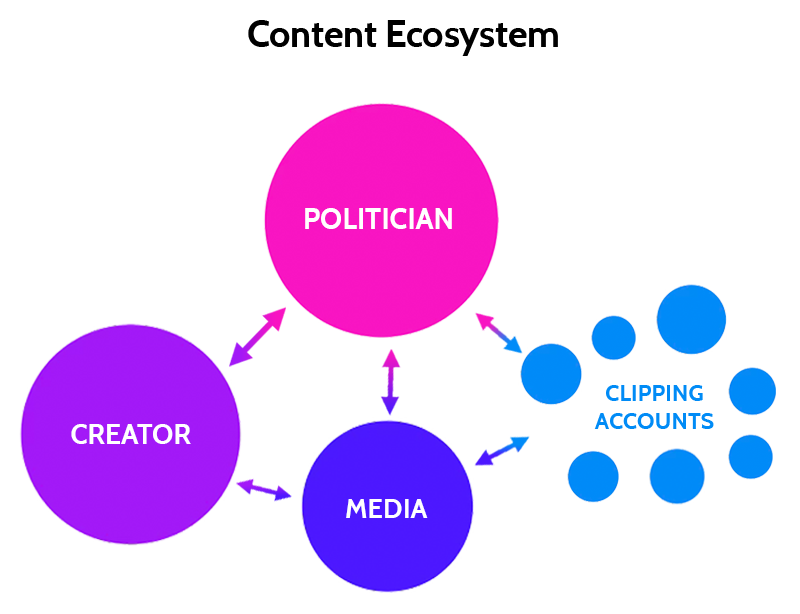
The solution is not to invest a bit more in content. Instead it’s to build a movement that can spot opportunities, create social-native content and stunts at speed, and work together to amplify these stories until they break out of social media and shape the mainstream agenda.
One reason the right has been so successful online is that they understand that social media is about people, not organisations. Audiences want to follow people who speak to them like fellow human beings, not polished brands. They want content that feels human, relatable and authentic.
That’s why creators are so powerful
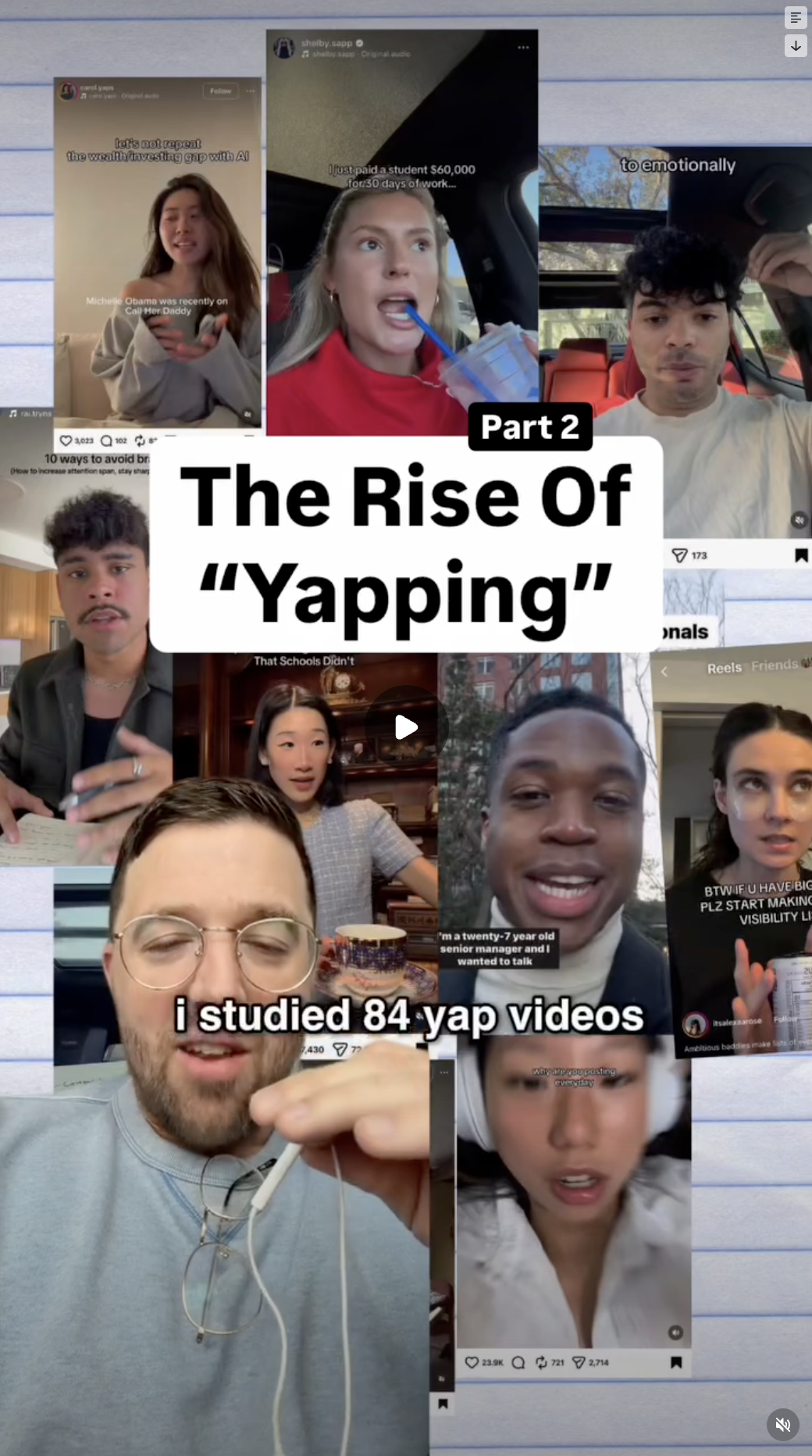
The most compelling creators make videos speaking from their own perspective. Two of the most viral types of video at the moment are the livestream and “yapping video”, both are where the creator speaks straight to camera, without a script. Organisations that need every word in a video signed off before filming simply can’t make these kinds of videos.
That’s one reason creators can jump on news stories straight away, and be the first to react to them, with their own personal take. This has enabled creators to build huge communities of people who want to hear their viewpoint.
But it would be a mistake to conclude that progressive movements just need to pay more influencers to make videos.
We should pay more creators but we won’t win a bidding war against the right.
Political creator Maria Comstock recently shared that she was approached by both left and right-wing funders to create content. For the same format, audience size and production effort, she said the progressives offered $2,000 and the right wing account offered $36,000. If we can’t outspend them, we will need to out-organise them. That means investing not just in content, but in the relationships, skills and coordination that build long-term power.
Video: bonusfootage
How movements are building narrative power
When it comes to social media, I’ve seen campaigns become high-quality content engines. My Voice, My Choice, the campaign fighting for safe and accessible abortion in the EU has an in-house production line of content, which pumps out 60 Instagram posts a day and has generated 500 million impressions a month. Working with them, I saw how they can create authentic presenter-led videos at a speed most campaign organisations can only dream of.
Their content didn’t just generate views, it helped secure over 1.2 million signatures for their European Citizens’ Initiative and a big breakthrough in access to abortion funding across the EU.
What’s remarkable about My Voice, My Choice, is not just their success on social media, but how rare it is. They have fewer staff and resources than lots of NGOs, and their model could be replicated by others.
Unlocking potential presenters
I’ve seen time and again there is huge untapped talent in our movement. There are lots of people who have the potential to become great presenters, but just haven’t been supported to.
At Greenpeace UK we delivered workshops to help staff create fast, social-native videos. One staff member, Anthony, went from having very little on-camera experience to creating a video in the workshop that generated 300,000 views.
But the bigger impact came from helping Greenpeace develop their in-house presenter skills, better understand the algorithm and build stronger partnerships with creators.
In the year following the training, Greenpeace generated more than 292 million Instagram views, a 243% increase on the previous year, while also doubling campaign actions.
Some of the people we worked with there have since gone on to have impact in other organisations. The benefits of investing in people often extend far beyond a single campaign or NGO.
Supporting members and staff to become creators
The TUC saw the power of helping their staff and members to become creators themselves. Craig Stewart works at the TUC but had never made videos before April last year when he started posting 3 videos a week on his own channels, speaking out on the climate and against the far right.
We helped provide coaching around formats, hooks and virality, and his content began reaching audiences that many campaign organisations struggle to connect with. In just over a year, he’s achieved over 15 million views, has 35k followers and has launched a podcast.
We helped TUC to build on that success by delivering training to more than 500 workers around the country and supported a cohort to launch and grow their own social media accounts.
This work shows that an organisation’s staff and members can be a source of powerful and authentic messengers. With the right support, organisations can help them develop the skills and confidence needed to reach huge audiences.
Building networks
As well as commissioning creators, organisations can play a crucial role in sparking collaborations and networks. In April, I joined Democracy Hub in São Paulo, where 40 creators from around the world came together to explore how they could use the Anti-Authoritarian Toolkit in their own countries. We ran video workshops that produced 15 videos reaching hundreds of thousands of people. But the real impact wasn’t just the videos that were created, it was the power of creators collaborating and building relationships with one another.
D-HUB has recognised that while in-person events have their downsides, they remain one of the best ways to build trust and networks. The relationships formed at these events can last for years and lead to new collaborations, projects and even organisations.
Building a solution
All of these examples point to the same conclusion. We don’t lack great people. We lack the infrastructure to scale what works. Instead of organisations and creators trying to figure this out on our own, wasting time reinventing the wheel, we need to share what we’ve learned.
We are lucky enough to be able to work with lots of individual organisations and creators. But working with groups individually won’t bring the change we need. We need more practical tools, in-person training, ongoing support, and coordination. And we need all of this at scale.
That’s why VideoRev is developing the Movement Video Accelerator to bring organisations, movements and creators together, share what works, and collaborate around key moments. We are also hosting a webinar to discuss these ideas more.
Join our webinar
Our upcoming webinar “From viral content to narrative infrastructure: How movements build power” will explore exactly these questions.
Joining me will be Pedro Telles from Democracy Hub, who will share lessons from movements around the world that are building the infrastructure needed to resist authoritarianism.
We’ll also be joined by Chiara K. Cattaneo, co-lead of Elemental, who will explore how philanthropy can resource narrative power and support long-term change.
Together, we’ll explore what today’s content ecosystems can teach us about power, why progressive movements struggle to scale what works, and how creators, campaigners and organisations can work together more effectively.
If these questions matter to you, we’d love you to join us on 8 July.
Join our webinar: From viral content to narrative infrastructure
8th July, 1-2PM BST
Sign up for the webinar
Join us on 8 July to explore how progressives can build stronger content ecosystems.